
Your website
Found by Google. Quoted by AI.
The websites Selvix writes get read by search engines and by AI assistants. Here is why, with, for each point, the public page where you can check it.
Let’s talk about your schoolPublic proof, not promises
The pages cited here belong to Move and Study, a Franco-Belgian agency present in fourteen markets, whose website was built by Selvix. Every claim points to a page that is live: open it and look.
Nothing here guarantees a ranking or a result. These are the conditions that make a website readable, and pages you can check yourself.
You write in one language
Your website’s texts are written by AI, then approved and edited by your school in a single language: the one you choose. Claude, Anthropic’s AI, generates and keeps up to date all the other versions. Nobody maintains fourteen versions by hand: the school maintains one.
See this page: the Move and Study website, in its fourteen versions.
Price pages that AI quotes
When a student asks ChatGPT or Perplexity “how much does a language stay in Sydney cost?”, the AI looks for a source that actually answers: prices in a table, an explained method, a verification date, in the language of the question.
Most schools hide their prices behind a form: an AI cannot quote them. Selvix pages are rebuilt every night from the re-read rates, and the “verified on …” date is only set when every amount shown has been checked against the source. When an AI quotes a page, that is a visitor who would not otherwise exist, with no advertising.
School promotions are also shown all year round, on a dedicated page: crossed-out price, calculated saving, and each promotion disappears on its end date. They come from the same source as the prices. See this page: school promotions.
See this page: the Australia prices page, in English, the same page for French-speaking Switzerland (in French, in Swiss francs) and in Japanese.
While you were asleep
Collection of the night of 3 November 2026
Figures from the latest collection, read on 3 November 2026 in the night’s logs.
Truly localised, not translated
The Japanese version converts into yen at the dated European Central Bank rate, talks about Japanese airports and carries the Japanese legal page. The French-speaking Swiss version converts into Swiss francs. And the page addresses themselves are written in the reader’s language.
See these pages: the prices of an English course in London, in Polish and the same, in Italian: the address, the title and the text are written in each language.
Same page, two markets: not a translation
The Australia prices page, side by side. Open both.
French-speaking Switzerland
Prices in euros with the indicative equivalent in Swiss francs, the verification date, questions and answers about the stay. In French.
Open the Swiss pageJapan
The same schools, in Japanese: indicative yen equivalent at the dated ECB rate, departures from Japanese airports, Japanese legal page.
Open the Japanese pageEvery photo described in every language
Photo descriptions, read by Google Images, by screen readers and by AI, are written for each language: never a single description copied everywhere. The photo of a school’s reception is described in French on the Swiss version and in Portuguese on the Brazilian version.
See these pages: a school page in Cape Town, Swiss version and the same school in Brazilian Portuguese (look at the photo descriptions in the page code).
Titles and descriptions written for each market
Titles and meta descriptions are generated automatically but written for each market: almost every page of every version has its own, in the reader’s language and with the reader’s reference points (the Swiss franc, the yen, the złoty), never a mechanical translation.
See these pages: the Polish page, the Italian page and the Swiss page: the browser tab title and the description differ from one version to the next.
A network of pages that reinforce each other
Every page is woven into a country, city, school, prices, quote network that Google and AI follow to understand the site: hundreds of pages that reinforce each other, placed automatically in every version.
See this page: on the Australia prices page, follow the links to the cities, their price pages and the quote request, then go back up through the breadcrumb.
Languages, linked to each other
Every page declares its sister versions to search engines (hreflang tags): the right reader gets the right language, with no forced redirect. The Australia prices page declares fourteen of them, plus the default page.
See this page: view the source of this page and search for “hreflang”.
Fast, and measured
PageSpeed mobile score of the Move and Study home page (move-and-study.com/en), measured on 3 November 2026 with Lighthouse, the engine behind PageSpeed Insights: performance 98, accessibility 97, best practices 96, SEO 100 (median of three runs).
Measure it yourself: PageSpeed Insights on the home page. The score varies from one run to the next; the date is the date of our measurement.
AI is becoming a reflex, worldwide
Every figure carries its source and its date. They describe the use of AI, not your website: they show why the question is no longer whether your students will go through AI, but how many.
The world
3.24 billion people use at least one of the main AI assistants every month, or 38.9% of the world’s population (October 2026). It is an estimate: one person may be counted more than once.
ChatGPT: 900 million weekly active users at the end of February 2026, up from 800 million in October 2025.
Manochi, via DataReportal, 21 October 2026
OpenAI announcement, reported by TechCrunch, 27 February 2026
Buyers
Used generative AI for shopping-related tasks online: 63% of Americans, 67% of Britons, 56% of Canadians and 61% of Australians.
In the United States, about one respondent in four says ChatGPT’s recommendations are better than Google’s.
Traffic from AI tools to US retail sites rose 693.4% over November and December 2025 compared with a year earlier; Adobe notes that the base of users remains modest.
Omnisend, Cint survey of January 2026, 4,000 consumers
Omnisend, July 2025 survey, 1,224 Americans
Adobe Analytics, 7 January 2026
Young people, schools’ clientele
Across six countries (Argentina, Denmark, France, Japan, the UK, the US), 59% of 18-24 year-olds used generative AI in the past week, against 20% of those aged 55 and over. Across all ages, weekly use went from 18% to 34% in one year.
Worldwide, 93.3% of internet users aged 16 to 24 say they used AI in the past month, against 52.2% of those aged 65 and over. That is the age of many language-stay students.
A look at two English-speaking markets, from the first source above: the United States and the United Kingdom are both among the six countries surveyed.
Reuters Institute, YouGov survey of June-July 2025, published 7 October 2025
GWI, via DataReportal, 21 October 2026
The trajectory, as these sources show it: ChatGPT goes from 800 to 900 million weekly users in four months, and weekly use across six countries from 18% to 34% in a year. We add no forecast: the question is no longer whether your students will go through AI, but how many.
A site quoted by AI, and an AI advisor at the door
Visitors who arrive from ChatGPT or Perplexity have already chosen to talk to an AI. They expect to ask their question and get an answer that advises and prices, not to fill in a form and wait two days. Sofia welcomes them exactly the way they expect.
The reverse is true too, and it should be said plainly: greeting that visitor with a scripted chatbot, one that recites three pre-written answers and asks for an e-mail address, is worse than a passive site. They have just compared, they see the difference at once, and they leave. A site quoted by AI with no AI advisor at the door wastes its best traffic.
A site that AI quotes brings visitors; Sofia turns them into enquiries. See how Sofia receives your visitors.
Try it yourself
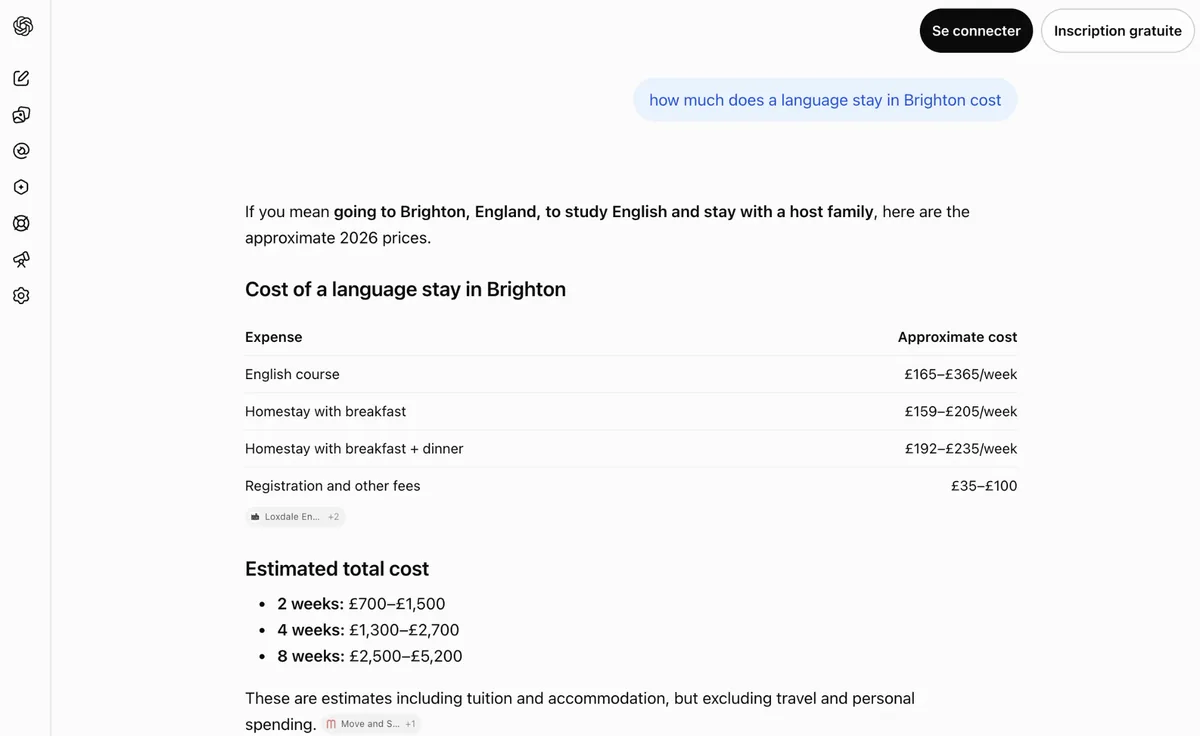
Ask ChatGPT how much a language stay in Sydney costs. See who is quoted.
We did it on 3 November 2026: ChatGPT quotes Move and Study as its first source. Move and Study was quoted that day, for that question; an AI’s answers change from one moment to the next and nothing guarantees it always will be.
We set up your school. You watch it run. Send us your price lists and catalogue, even as PDFs: see set-up on the Pricing page.